

Where’s my H? Restoring hydrogen atoms in inorganic crystals
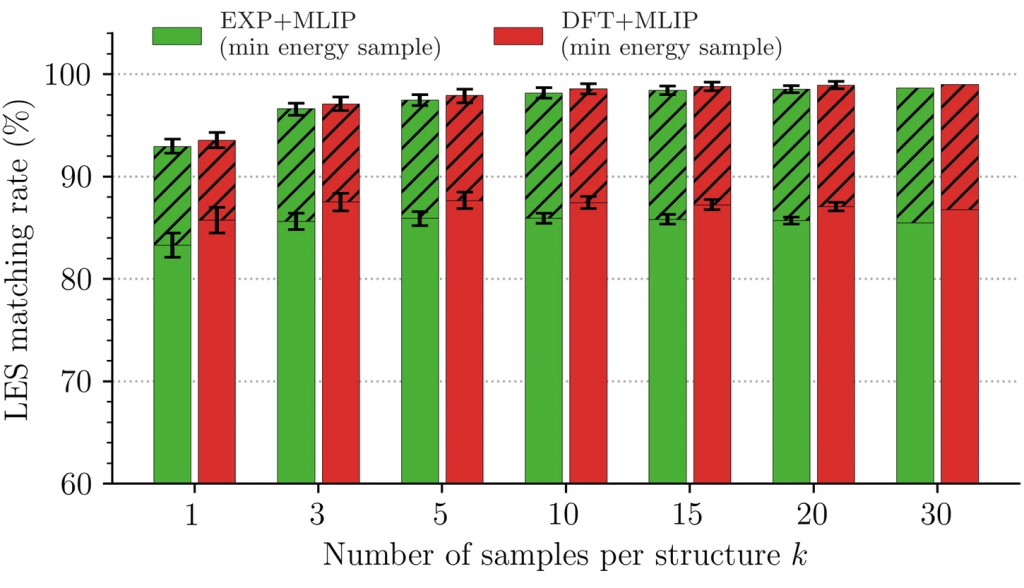
Score-based diffusion models for accurate crystal-structure inpainting and reconstruction of hydrogen positions.
T. Reents, A. Cantarella, M. Bercx, P. Bonfà, G. Pizzi
npj Computational Materials 12, 203 (2026)
Image inpainting, the process of recovering a missing or altered region of an image, is a challenging task in computer vision that has recently seen major advances from machine learning techniques.
But what if, instead of pixels of kittens, we are interested in the atoms of crystals? In a recent manuscript, we show how similar approaches can be used to reconstruct missing hydrogen atoms in inorganic crystals. This is a longstanding problem in structural refinement from X-ray diffraction, since hydrogen has the lowest scattering power of all elements and is therefore difficult to locate reliably. While alternative techniques exist, X-ray diffraction remains one of the most accessible and widely used methods for crystal characterization.
Our approach combines machine learning and density functional theory and enables us to refine hydrogen positions in inorganic periodic structures with 97% accuracy.
Watching spins switch tracks: predicting intersystem crossing in quantum defects
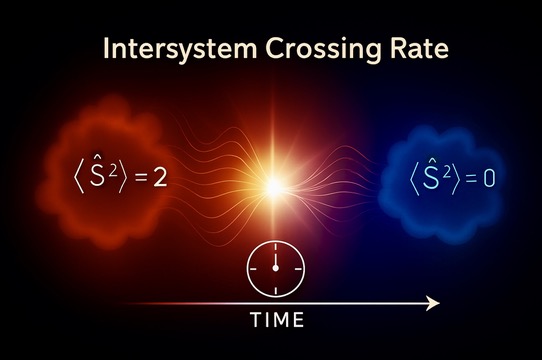
First-Principles Framework for the Prediction of Intersystem Crossing Rates in Spin Defects: The Role of Electron Correlation
Y. Jin, J. Park, M. M. McMillan, D. D. Ohm, C. Barnes, B. Pingault, C. Egerstrom, B. Huang, M. Govoni, F. J. Heremans, D. D. Awschalom, G. Galli
Phys. Rev. Lett. 135, 036401 (2025).
We developed the first fully ab initio framework capable of accurately predicting intersystem crossing (ISC) rates in solid-state spin defects — a key process underpinning optical initialization and readout of qubits in quantum technologies. Using the nitrogen-vacancy (NV⁻) center in diamond as a benchmark, our approach combines quantum defect embedding theory (QDET), advanced treatments of spin-orbit coupling (SOC), and a rigorous evaluation of electron–phonon interactions including dynamic Jahn–Teller and Herzberg–Teller effects. We validated the developed method with experiments carried out on diamond.
A central innovation of this work is the ability to capture electron correlation in many-body defect states while fully accounting for finite-size effects in realistic supercells. This yields quantitatively accurate ISC rates and SOC parameters, resolving long-standing discrepancies between previous theoretical approaches. Our predictions show excellent agreement with fluorescence-lifetime measurements over a broad temperature range, demonstrating predictive, experiment-validated accuracy.
Crucially, our method is general and scalable to hundreds–thousands of atoms, enabling reliable modeling of ISC and optical spin-polarization cycles in a wide variety of quantum defects. This framework paves the way for high-throughput discovery and rational design of solid-state qubits with tailored optical and spin properties.
Unveiling the nature of electronic transitions with 𝜇SR
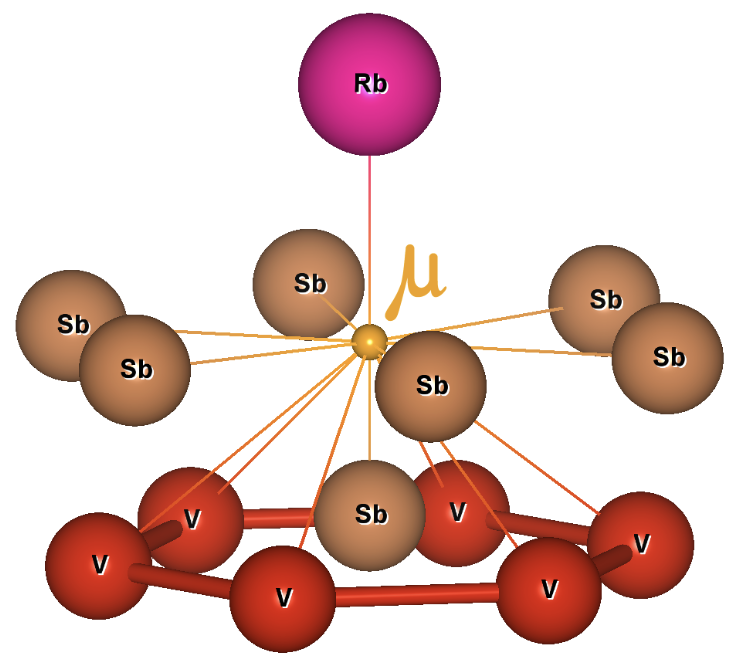
Unveiling the nature of electronic transitions in RbV3Sb5 with avoided level crossing 𝜇SR
P. Bonfà, F. Pratt, D. Valenti, I. J. Onuorah, A. Kataria, P. J. Baker, S. Cottrell, A. C. Salinas, S. D. Wilson, Z. Guguchia, S. Sanna
Phys. Rev. Research 7, L032046 (2025).
Our combined experimental and computational study reveals an evolving charge landscape within the charge-density-wave state of the newly discovered kagome superconductors AV3Sb5. Notably, its temperature dependence matches that of the previously proposed time-reversal symmetry-broken state, underscoring the importance of both effects in determining the intertwined phases of these materials.
This analysis, based on avoided-level-crossing muon spin rotation spectroscopy, DFT+μ simulations, and a first-principles description of the muon polarization function, also introduces an alternative approach for characterize charge states and charge dynamics in these systems, complementing the results of other bulk techniques such as NMR and NQR.
Understanding new extended chiral molecules
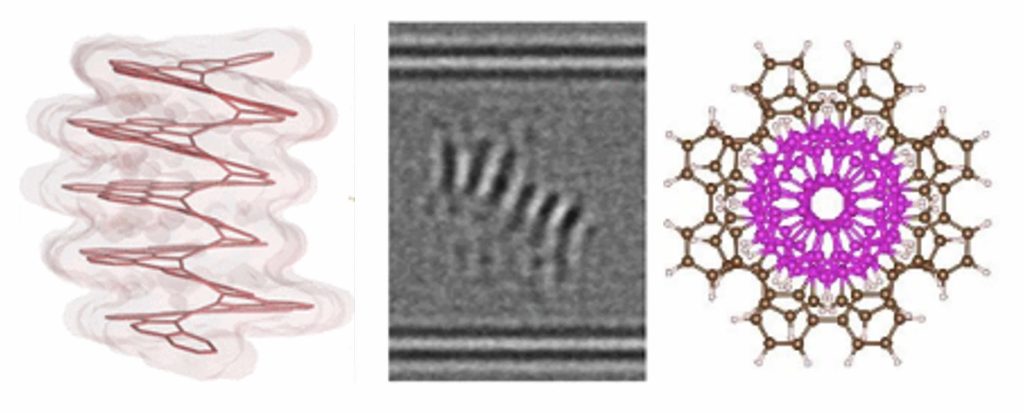
Laterally π-Extended Polyhelicenes
H. Wu, Z. Qiu, G. Wen, A. Hinaut, K. Harano, R. Graf, D. Prezzi, L. Estaque, Y.-L. Tsai, D. Schollmeyer, G. Pieters, E. Molinari, R. Pawlak, E. Meyer, K. Kimoto, H. I. Wang, M. Bonn, K. Müllen, A. Narita
J. Am. Chem. Soc. 147, 43842 (2025).
Through an interdisciplinary worldwide collaboration of experimental and computational scientists from chemistry physics and engineering, this work demonstrates for the first time the synthesis and unique properties of helicene polymers: the laterally π-extended polyhelicenes (EPHs). Helicenes are a fascinating family of organic molecules distinguished by their spiral-shaped structures. Their helically extended π-conjugation not only imparts chirality but also unique (opto)electronic characteristics, valuable for applications ranging from molecular recognition and asymmetric catalysis to chiroptical devices and spin filters. Achieving polymers, and their remarkable intrahelix conductivity, further opens the way to nanoscale solenoids, spin-selective electronics, and future high-frequency nanoelectronic devices. The research performed in our group (together with Deborah Prezzi, Cnr-Nano Modena) shows how the ideas and tools of solid state theory contribute to understanding the extended states of molecular systems.
Evidence for equilibrium exciton condensation in monolayer WTe2
Evidence for equilibrium exciton condensation in monolayer WTe2
Bosong Sun, Wenjin Zhao, Tauno Palomaki, Zaiyao Fei, Elliott Runburg, Paul Malinowski, Xiong Huang, John Cenker, Yong-Tao Cui, Jiun-Haw Chu, Xiaodong Xu, S. Samaneh Ataei, Daniele Varsano, Maurizia Palummo, Elisa Molinari, Massimo Rontani, David H. Cobden
Nat. Phys. 18, 94 (2022).
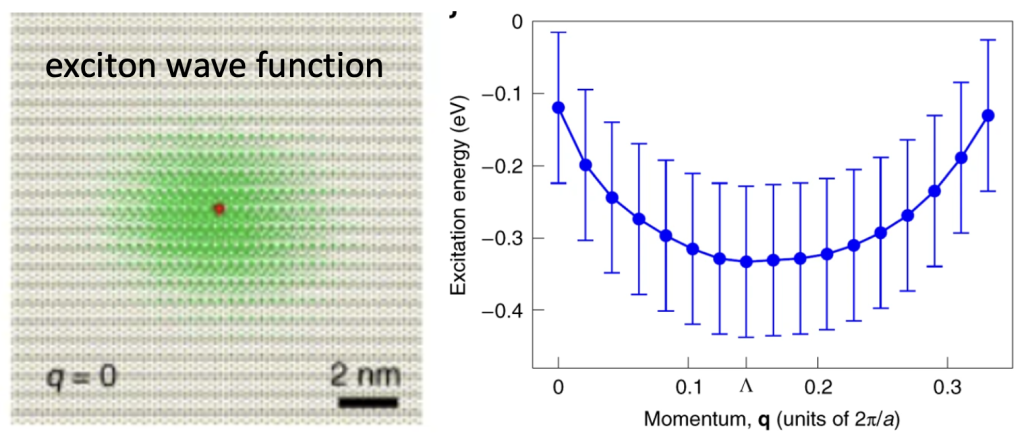
The excitonic insulator (EI) is a macroscopic quantum coherent state made of excitons, electron-hole pairs bound by Coulomb attraction, which spontaneously form and condense at thermodynamic equilibrium in the absence of photoexcitation. Here we focus on a prototype two-dimensional (2D) system, WTe2, and present evidence of the formation of this new phase of matter that was initially proposed by W. Kohn and others in the ‘60s. We use first principles calculations to show that the exciton binding energy in WTe2 is larger than 100 meV and the radius as small as 4 nm, as a consequence of the reduced screening in 2D, explaining the experimental evidence of exciton formation at high temperature and doping levels. Our mean field model description then predicts the stability and properties of the EI phase. The results are consistent with sophisticated transport experiments performed by the Seattle group of D. Cobden, and with results from other groups that were published simultaneously, thus confirming the realization of the EI in WTe2.